Matthew Lenz and the Craft of Feeding the Crowd
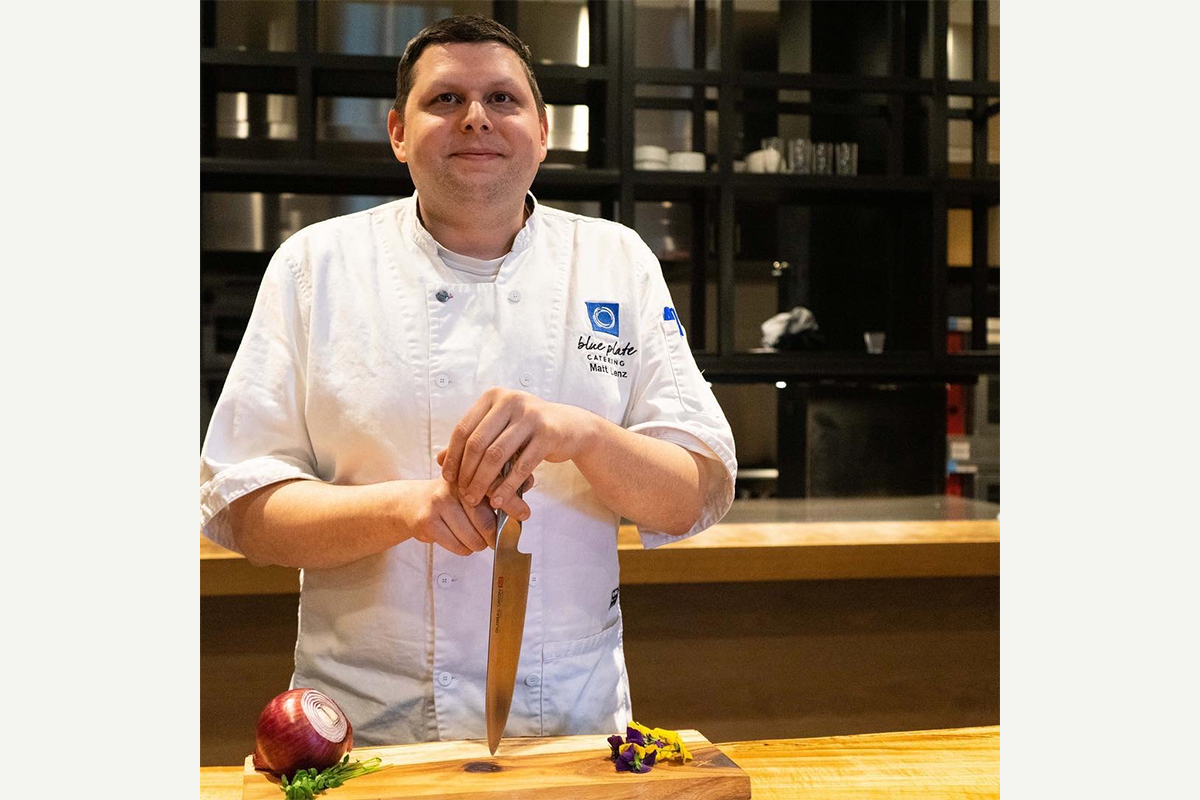
In the kitchen, chef Matthew Lenz brings big-picture thinking to every carefully prepared dish. (Photo courtesy of Matthew Lenz)
Matthew Lenz has built a career out of understanding how food works at every scale – from the family breakfast table and championship-game catering to Chicago banquet halls and the exacting rhythms of a production floor in South Carolina.
He’s drawn to the planning, the timing and the invisible labor that makes a large operation run.
Lenz says he began cooking at about 7 years old, making breakfast for his family and watching the kitchen habits of his parents, who each had their own domestic specialties.
“I’ve always been in the kitchen,” he said.
By high school he already had begun learning the harder realities of restaurant life: the line, late hours and discipline required when service begins and stops on someone else’s schedule. He later earned an associate’s degree in food service management and culinary arts in 2002.
That practical formation began to take shape at the University of Montana, where Lenz worked in catering in the UC and helped serve home Griz games.
It was an early lesson in scale, pace and the odd exhilaration of feeding a crowd that already has its attention fixed elsewhere.
After graduating, Lenz stayed in the Missoula area for a time, working in restaurants and taking on projects that expanded his sense of what food service could be. He helped with a hospital cafeteria and later moved through a series of jobs in Bigfork and Seeley Lake. At Seeley’s Double Arrow Resort, he served as executive chef for six years. There were side ventures too: a bar and grill, then a pizza place of his own. He kept moving toward larger stages and more complex operations.
That restlessness carried him back to Chicago, where he had grown up before his family moved to Montana in the 1990s. Later, a sight-unseen opportunity in Chicago changed his trajectory again.
“I hopped on an airplane with a bag and didn’t look back,” he said. The leap led to a decade in catering, first with Blue Plate and then Limelight, where he rose into leadership and found himself working events that require feeding a lot of mouths while maintaining a sense of calm.
For Lenz, catering solved a problem restaurants never quite could. In a restaurant, he said, a rush can feel endless. In catering, “You know you’re going to get hit really hard, and it’s just going to be once.”
That finite burst of intensity appealed to him, as did the variety: one day a wedding atop the Willis Tower, the next an event at the Lincoln Park Zoo. He liked the planning before the event and the relief after it – the sense that all the hidden work would culminate in a single decisive moment.
He also liked being in the middle of things no one outside the room gets to see.
“I’m the type of person that wants to know what’s going on behind the scenes,” he said.
Catering allowed him to be close to public moments without having to stand in the foreground.
The COVID-19 pandemic forced the next turn. While still in catering, Lenz and his colleagues pivoted into U.S. Department of Agriculture production to keep the business moving. That brought him into food manufacturing and eventually into contact with Wow Bao, the Chicago brand expanding into grocery shelves. He did consulting work, remained in touch and was eventually persuaded by a friend to join the company after nearly a year of coaxing.
“You can know what a Saturday is like again,” Lenz said of the pitch. He took the offer, came aboard as a research and development chef, and helped with compliance and co-manufacturing before the company decided to build its own USDA facility in Forest City, North Carolina. Lenz became deeply involved in the planning and execution of that project, and when production began, he moved to South Carolina to become assistant plant manager.
At Wow Bao, Lenz helps oversee the production of steamed bao buns and soup dumplings. He also leads innovation, food safety and quality assurance. The plant itself is immense – roughly 70,000 square feet – and everything in it depends on timing. Ingredients arrive, are sliced or diced or marinated, move through dough-making and forming, then steam, freeze and pack before heading out as finished product.
Yet for all the scale, Lenz insists the work remains hands-on.
“We like to be able to say that we have more care that goes into our product,” he said.
The soup dumplings, for instance, are still picked up by hand, inspected and placed into trays one by one. The company begins with whole ingredients and avoids fillers – a choice he sees as both culinary and moral.
“We stand behind having a really high culinary forward product,” he said.
Lenz is especially interested in challenging older assumptions about processed food. He believes food manufacturing earned a poor reputation in the late 1990s and early 2000s, when many companies prioritized cheap volume over quality. But he sees that landscape changing. Frozen food, he said, now looks very different than it once did: more premium products, more thoughtful ingredients, more companies trying to make packaged food taste less like compromise.
At the center of that argument is a distinction he returns to repeatedly: Manufactured does not have to mean diminished. To him, the problem isn’t the size itself but what a company chooses to preserve at scale. A soup dumpling can still be built around boneless chicken thigh. A frozen meal can still be made with care. A plant can still retain some of the attentiveness of a kitchen.
Lenz’s career never settles into one register. Each stage seems to have given him something the next one required: discipline, adaptability, composure and a respect for the systems that puts food on the table.