UM Alumni Reimagine Montana Agriculture One Raspberry at a Time
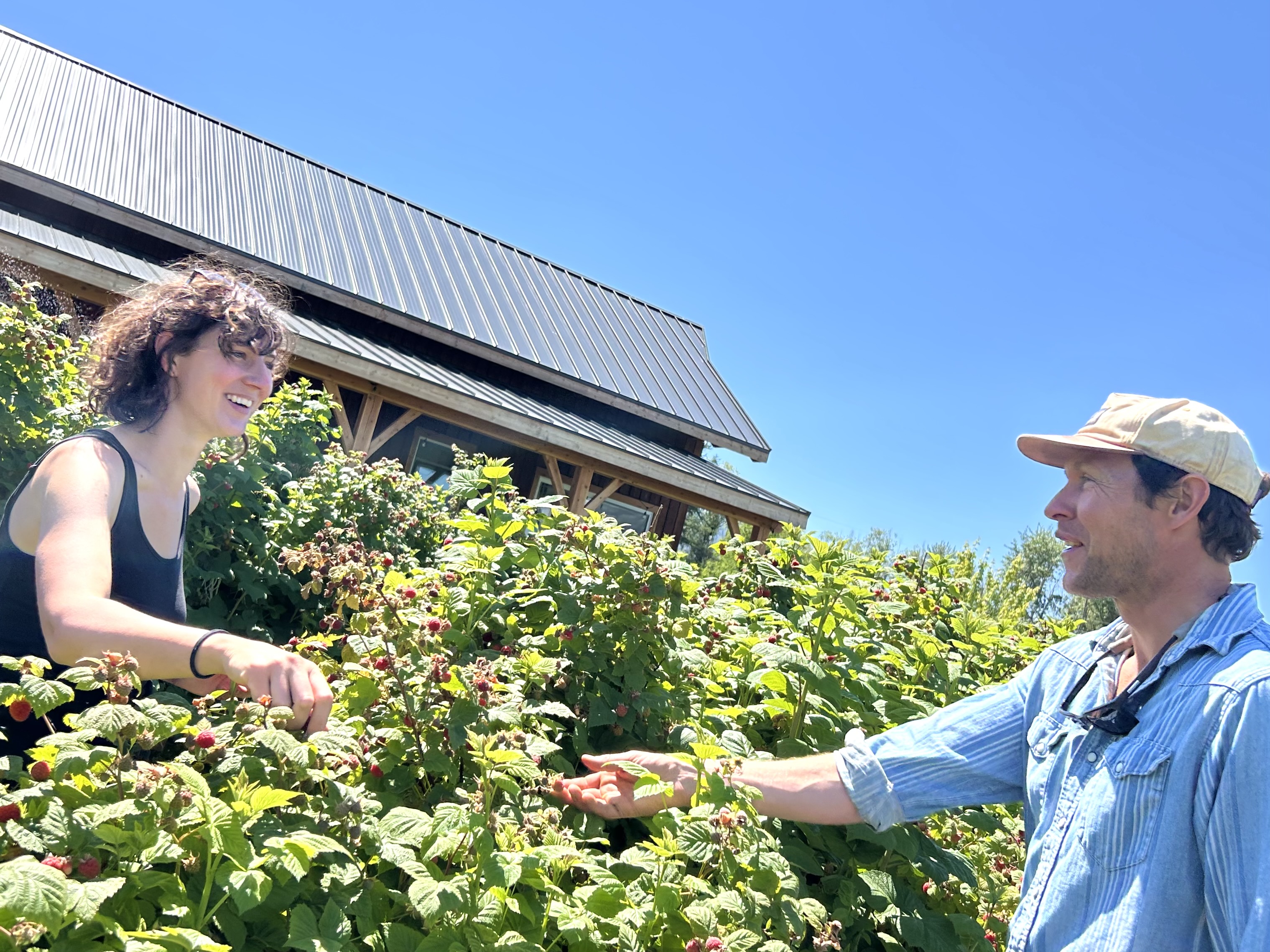
On a bright summer day in the Mission Valley, Thunder Road Farm feels less like a business than a vibrant argument for a different way of life in Montana.
Raspberries ripple in the sun and cows move across the landscape with practiced calm. All of it shaped by two University of Montana alumni who have spent years building a place that is agricultural, ecological and communal.
The farm outside Arlee belongs to Gillian Thornton-Andrews and Bryce Andrews, a couple whose path to one another began, improbably, in a car wreck on Interstate 90. On a snowy winter night, Thornton-Andrews lost control on black ice and spun into the median. Andrews stopped to help, and the two spent time talking while they waited for a tow truck. What could have been a miserable and frightening night became, as they tell it, the first chapter in a shared life that eventually led them to western Montana. They both graduated from UM and now share a farm that combines cattle, raspberries, events and conservation-minded stewardship.
“It just changed the trajectory,” Thornton-Andrews said of that encounter. “You never know when you’re going to meet the person.”
Their story is full of the kind of practical compromises that define real life on the land. It is also full of idealism — the stubborn, ordinary kind that keeps people moving cattle, rebuilding infrastructure, restoring native habitat and trying to ensure the food they produce is good for both the land and the people who eat from it.
Thornton-Andrews, who grew up in Kalispell, did not come from an agricultural background. She studied at the University of Oregon before finding her way to UM, where she was drawn to environmental studies and the intersections of local food systems and place-based education.
“I got much more interested in seeing how I could put myself in a career that would allow me to work with the natural world and also perhaps influence the food system,” she said.
After graduate school, she worked as an educator for several years before returning to farming full-time.
Andrews took a different route. Raised in Seattle, he came to Montana after college to work on ranches, then returned to UM for a master’s degree in environmental writing. Along the way he began a writing career that now includes several books and a long relationship with working lands in Montana.
“I had developed a really strong set of convictions about the importance of practicing agriculture in a way that improves the ecological integrity of the land — that feeds the community,” he said. “This was something I was working toward pretty much my whole adult life.”
The couple’s connection to the University remains visible in many places. Both have taught at UM, and Andrews also served as a visiting writer there. Their farm is now tied to UM in another way: Thunder Road Farm is the host site for a UM Alumni Association event on July 31.
The land was made accessible to the family because the previous owners placed a conservation easement held with Five Valleys Land Trust. This decision lowered the value of the land enough to make the purchase possible for the Andrews family. Andrews described the easement as central to their ability to begin ranching and farming on a place they otherwise could not have afforded.
“We were really lucky,” he said. “Five Valleys connected us with an amazing couple who wanted to see the land remain intact and were excited about our farming vision.”
That arrangement also shaped the farm’s future. Under the restrictions of the easement, the property can’t be subdivided and any new structures built outside of certain building envelopes must be for agricultural use. The couple knew from the start they would have to work within the realities of the land rather than try to remake it entirely. They moved there in 2018 and spent the early years learning how the property functioned seasonally, what the infrastructure needed and how to balance agriculture with wildlife habitat and the surrounding landscape.
“The farm is also within the Flathead Indian Reservation, and we see it as our responsibility to be good neighbors, responsible land stewards and to support tribal sovereignty,” Thornton-Andrews said. “We want to be sure that this farm is a place that can be part of the community, not separate."
The farm sits on the edge of a wild part of Montana, where grizzly bears, black bears, mountain lions and wolves are part of the setting, not just the background.
“We’ve seen all of them,” Thornton-Andrews said.
That work has been both philosophical and physical. Early on the couple rebuilt a dangerous corral system, improved water access for rotational grazing and figured out how to make the whole property function more reliably as a ranch.
“It was terrible,” Thornton-Andrews said of the original corral system. “Whoever had built it before had done it very piecemeal.”
They added stock tanks, adjusted fencing and learned how to manage flood irrigation while trying to keep the operation aligned with their values.
“You have to recognize that there are limitations because of where it’s situated,” she said. “We can’t just mold this property to be whatever we want it to be.”
Andrews framed the work in larger terms.
“We take our meat to farmers market, so we connect directly with people,” he said. “It makes communities closer, and it makes strangers into individuals for you.”
For the family, agriculture is more than just production. It’s a relationship to the land, neighbors and the people who buy what they raise.
The raspberries came later, and they changed everything. Thornton-Andrews said the crop made sense both practically and emotionally: Raspberries thrive in the climate, and unlike many forms of farming, raising them is less punishing on the body.
“They’re just the best fruit,” she said.
With help from a Farm Connect Montana grant, the couple planted 18 varieties of raspberries and treated the project as a kind of field trial. They were looking for what would grow best in the valley, and they planned to share that information with other farmers rather than keep it to themselves.
“The grant is to share information between farmers, which is super cool,” Thornton-Andrews said.
The scale of the raspberry operation has grown rapidly. They began with 1,000 canes in 2021, and now the plants are fully mature. Visitors come to pick berries themselves, which makes the experience immediate and personal.
“Everyone is welcome during our open ‘u-pick’ hours,” Thornton-Andrews said.
That accessibility is key to the farm’s foundation.
“We don't want to just have fancy farm dinners," she said. "Although we do occasionally want to do that, too."
Andrews sees the crop as both practical and joyful.
“I’ve never seen an unhappy person in this raspberry patch,” he said. “It’s one of the most unquestionably joyful and beneficial things I’ve ever been part of.”
The barn changed the farm again. Finished last summer, it allowed the couple to expand into agritourism and farm-based events, including dinners, music and private gatherings. The UM Alumni Association’s July event, Grizzly Pick & Pour, is part of that evolution.
The event will run from 5 to 7 p.m. at The Barn at Thunder Road Farm in Arlee. Guests will get a private raspberry picking experience, then gather for a barn happy hour with beverages, snacks and time with fellow Grizzlies. Registration includes one pint bucket for berries, and space is limited.
“It’s a form of agritourism that supports local farming operations,” Thornton-Andrews said.
For the Andrews family, the idea is not simply to host events, but to create a place where community and agriculture reinforce one another.
“It’s really cool because people can come out here and they’re part of what we’re doing,” Andrews said.
There is a sense, listening to the couple, that Thunder Road Farm is their answer to a broader question about what agriculture in Montana can look like now. They do not talk as though the old model — large, cheap expanses of land worked in isolation — is available to many young farmers anymore. Instead, they describe a landscape that demands creativity, diversification and partnerships.
“That’s what agriculture is going to look like in our part of the world,” Andrews said. “You have to be very creative about how you augment the raw agricultural production of the land.”
That is why the farm has cattle, raspberries, events and conservation all at once. It is why the business depends on multiple revenue streams and why the couple sees their work as both economic and civic.
“If it didn’t feel like we were making a net good, we wouldn’t be doing this work,” Thornton-Andrews said.
And on a sunny day in Arlee, with their children moving in and out of the scene and berries arriving by the handful, that vision feels less like an argument than a reality already in motion.
Thunder Road Farm invites people to learn more through its website and social media channels. Those interested in attending the July 31 Grizzly Pick & Pour at The Barn at Thunder Road Farm can reserve a spot through GrizHub before the berries are gone.