UM Alum's Business Helps Customers Grow Fruit in Cold Climates
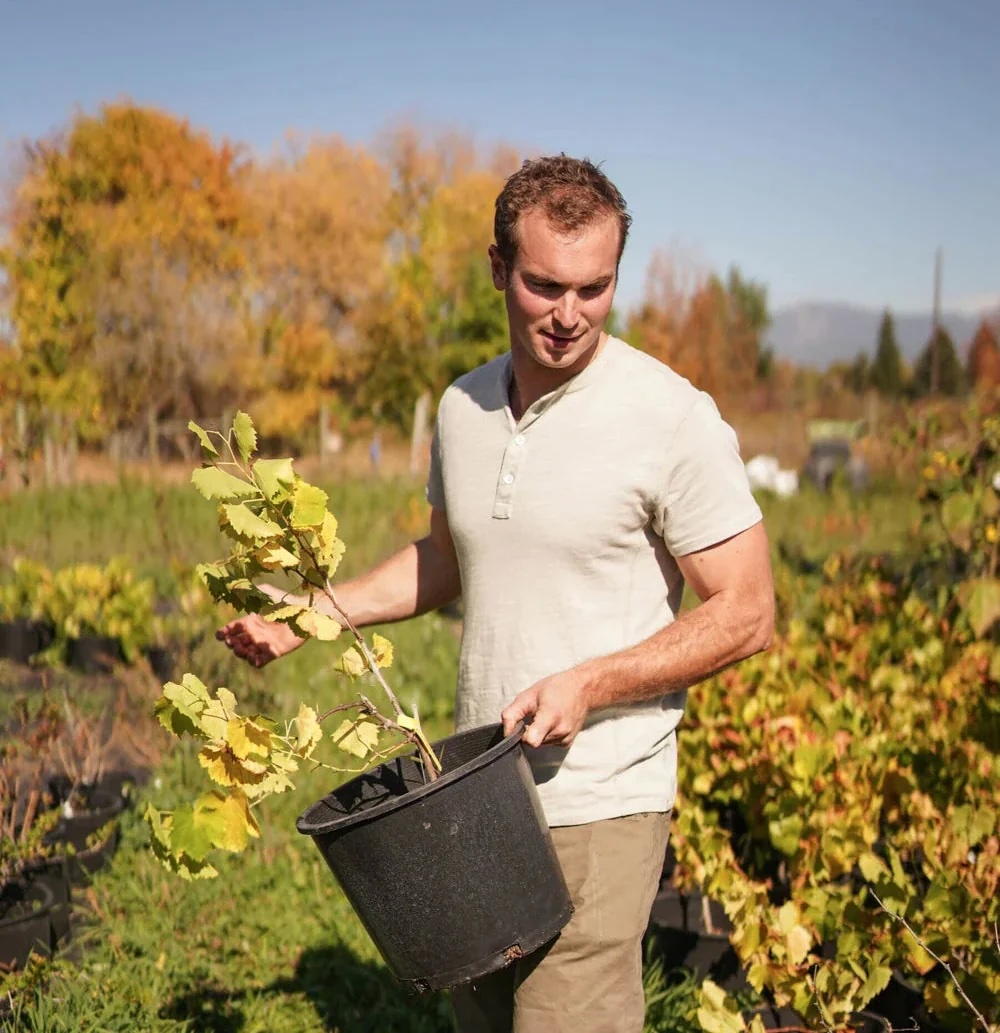
Luke Robinson first became interested in Montana as a teen, when a family friend with kids enrolled at the University of Montana spoke about the beauty of Missoula and its surrounding areas. The stories appealed to Robinson so much that he really only had one place in mind when it came time for college.
“Montana was kind of calling me,” Robinson said.
He arrived at UM to study art in the College of Arts and Media. Robinson liked to draw and was interested in a career in architecture. He enjoyed his studies but decided to seek out an internship before fully committing to an architectural degree.
This eventually led Robinson to Portugal, after he stumbled across an online posting looking for a designer to create a composting toilet bathroom on a permaculture farm in northern Portugal.
“I had no idea what any of that meant, but I said, ‘Let’s do it.’”
The farm was designed to mirror the structure and function of a natural forest ecosystem—layered with climax fruit and nut trees, productive shrubs, and an understory of herbaceous perennials and vines, all grazed by ducks. A network of subsurface irrigation canals, fed by a stream diverted upslope, completed the system. Coming from the Midwest, where standardized fields of corn stretched for miles, this way of farming stood out to Robinson.
“This was the opposite of what I’d seen, so I got really interested in growing food with systems science as the backbone,” he explained. “We guide the path forward so the crops can thrive on their own, and we just nudge them in the right direction.”
Robinson left the internship in Portugal feeling a bit dismayed.
“I realized I didn’t want to pursue architecture after all. It was disappointing—I’d invested years into that path—but also a relief to discover it sooner rather than later.”
Although less involved in the day-to-day operations on the farm in Portugal, Robinson did take several audio recordings of tours that the farm owner had given. Unsure of how to move ahead after the trip, he decided to listen to the audio recordings of the farm tour.
“I had an epiphany while listening to the recording for the second time—about how the farm owner had left his career as a Systems Scientist at the Royal Institute of Stockholm to apply his theories on the land. He talked about ecosystem mimicry, nutrient cycling, energy flow and the role of species diversity. He cited resource after resource, and I tracked them all down and devoured them.”
This path eventually led Robinson to enroll in the Systems Ecology graduate program at UM. But coming from an art background and stepping into a science degree meant that funding options were limited. To pay for school, he began buying fruit trees from wholesale nurseries and selling them directly to customers out of a storage unit. When the COVID-19 pandemic accelerated online retail, the idea of turning it into a full-time business suddenly became real.
Montana Fruit Tree Co. launched with the mission to increase food production capacity for everyone from hobby growers and commercial growers to homeowners with an acre or less. Robinson believes homegrown fruit is special and that you can taste the difference with one bite.
“You have to think about soil, climate, plant physiology, ecology, hydrology, land shape and more,” he explained. “All these factors culminate in flavor, which I believe is what inspires people to grow their own food.”
His company specializes in plants suited for colder climates. He acknowledges that fruit production might not be the first thing that comes to mind when you think of a state like Montana, but many varieties have been bred to withstand a bitter winter.
“It’s not easy, but there are a ton of really reliable crops that can be grown,” Robinson said. “People have done a lot of work to get high-quality fruit in marginal climates by either pulling from genetics in other cold climate analogs, research breeding stations, backyard DIY breeders, and others.”
The company sells fruit-bearing trees, shrubs and vines online and also helps customers choose varieties and design layouts that work for their farms or homesteads. Robinson’s goal is to inspire others to grow their own food. He credits his unique educational background with driving his career forward.
“Having an art undergrad and heavy science in grad school was really helpful. Both programs were great.”
He encourages students interested in farming and food production to get creative in their approach and take advantage of the thriving agricultural communities around the state.
“Acquire as much knowledge as you can,” he said. “There are a lot of emerging markets you can look for. We have so many resources in Montana.”