Chasing Human Stories
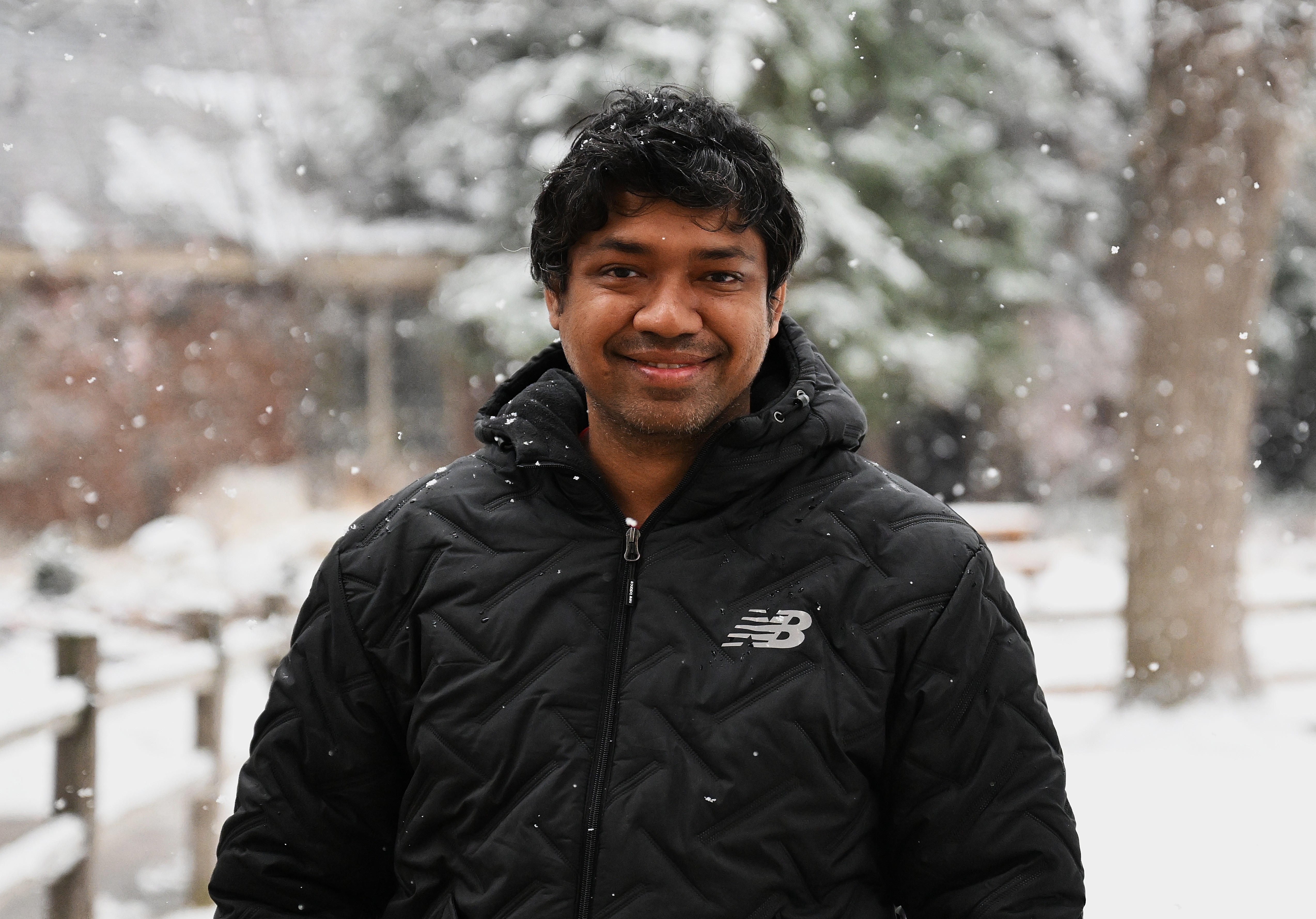
From the Teesta to the Blackfoot, Mosabber Hossain reports on the people experiencing environmental change. (Photo courtesy of Phoebe Mather)
From Bangladesh’s Teesta River to Montana’s Blackfoot, journalist Mosabber Hossain follows the human consequences of environmental change.
Long before Mosabber Hossain learned to report on climate change, he watched people describe what a river had taken from them.
He grew up near the Teesta River in Bangladesh, where flooding and erosion could turn a family’s home, fields and livelihood into memories. He remembers people crying as they spoke about their losses. Later, as a journalist, he returned to communities like those he had known as a child, asking how families managed displacement and how children continued their education when the places that anchored their lives disappeared.
Years later, reporting in Montana, he encountered a different landscape and a familiar question: What happens to people when the environment they depend on changes?
There were children whose lives were disrupted by wildfire smoke and extreme heat. There was a proposed gold mine near the famed Blackfoot River. There were people grieving damage to a beloved ski area, describing not simply a place to ski but a repository of childhood experiences and family memories.
The rivers were different. So were the threats, histories and circumstances. But Hossain recognized a connection.
“Environmental change is never only about the environment,” he said. “It is about people's homes, health, education, livelihoods, memories and sense of belonging.”
That mindset carried him from an established newspaper career in Bangladesh to the University of Montana, where he is completing his master’s degree in environmental science and natural resource journalism. He arrived with international reporting experience and a clear goal: to become a better journalist by learning to connect the human stories he knew how to tell with the science behind them.
Leaving a Good Job
Hossain did not come to Montana because his career hit a wall.
He had worked his way from contributing reporter to a permanent position at a leading Bangladeshi newspaper. In 2014, as a young reporter, he spent three months investigating financial corruption involving lawmakers and ministers. The resulting front-page coverage drew public attention and earned him a South Asian investigative journalism award from the Thomson Foundation.
More than a decade later, the Thomson Foundation again highlighted Hossain’s work during its 60th anniversary, featuring him as one of eight alumni whose journalism and professional journeys were profiled. The recognition connected his early investigative work in Bangladesh with a career that had since expanded into international climate and environmental reporting.
Hossain spent much of that career at Prothom Alo, one of Bangladesh’s most widely read newspapers, where he worked in investigative and environmental reporting before coming to Montana.
His international work later included reporting for Reuters, and two of his climate stories were featured on the World Economic Forum’s Agenda platform.
Recognition opened doors beyond Bangladesh. He spoke at an investigative journalism conference in Norway in 2015 and began freelancing for Reuters in 2017. His environmental reporting reached international readers, including through stories about the financial burden climate change placed on people with little money to spare.
Still, professional success did not settle the question of what he needed to learn.
He wanted a deeper grounding in environmental journalism. He studied UM’s courses and followed the work of a friend from Bangladesh who had attended the program. Missoula’s setting appealed to him, too. He wasn’t looking for the pace of New York City or Washington, D.C. He wanted a place where there was room to breathe.
A fully funded opportunity made the decision possible. Taking it meant leaving a good salary, a familiar newsroom and his family.
His wife, Farhana Hossain, a government officer, remained in Bangladesh with their young son, Mashair Hossain. Hossain knew he would miss an irreplaceable period of family life. He also believed the education could shape the rest of his career.
People asked why he would leave when he was already doing well. For him, the answer wasn’t that his prior work lacked polish. It’s that he had more to learn.
Learning the Science
The transition tested his moxie.
Hossain was studying in a language that was not his first, in a country whose reporting customs were unfamiliar. He also came from a nonscience academic background. The environmental subjects that had supplied the substance of his journalism now demanded another kind of attention: coursework, research and an understanding of scientific processes.
He could describe what people were experiencing. He wanted to understand more precisely why they were experiencing it.
Leaving so much behind gave those challenges urgency. When the work was difficult, he reminded himself that he had come deliberately, for reasons that still mattered.
He credits UM professors, along with classmates and the program itself, with helping him make that transition. He received the Bertha Morton Scholarship, a recognition of his graduate work. He also began extending his interests into collaborative research.
As a co-author, his narrative review examining climate variability, environmental change and Nipah virus spillover in Bangladesh appeared in a Q1 public-health journal. Another co-authored paper, examining measles misinformation on social media during Bangladesh’s 2026 outbreak, is ready for submission.
The projects bring together questions he once might have approached only as a reporter: how environmental conditions affect health, how people understand risk and how information circulates.
Finding the Human Story
An internship at Inside Climate News gave him an opportunity to put his education to work.
Hossain applied repeatedly for internships while watching classmates find placements. When the interview opportunity came, he prepared to explain both what he had already accomplished and what he wanted to report in Montana.
He brought international experience, a developing scientific foundation and a list of story ideas. He also benefited, he said, from the newsroom’s familiarity with UM through a previous student’s work.
During the summer, he reported on proposed gold mining near the Blackfoot, the effects of wildfire smoke on children and the ties among winter conditions, heat and wildfire risk. His story about children and smoke was widely republished and shared, and Covering Climate Now recognized it among notable climate stories.
Inside Climate News featured him in a podcast highlighting its fellows. His editor later extended his work into the fall semester as a fellow.
Recent stories also have been republished by major U.S. publications, including 50 years old Mother Jones and Grist, extending the reach of his Montana reporting to national audiences.
Hossain was also selected for the Oxford Climate Journalism Network, a program of the Reuters Institute for the Study of Journalism at the University of Oxford. Through its six-month online program, participating journalists met regularly with leading climate scientists and experts from around the world and explored how climate change intersects with health, justice, finance and other major areas of public life.
Those opportunities also exposed the differences between knowing how to report and knowing how to report in a new place.
On one trip to Lolo, Hossain spent an entire day without finding someone to interview. In Bangladesh, he was accustomed to encountering people readily and approaching them directly. Montana required other methods: social media searches, introductions through acquaintances, community organizations and messages that might not receive a response.
Finding a source was only the beginning. He describes learning from a newsroom process in which multiple editors examined his reporting, checked details and helped prepare stories for publication.
That scrutiny became part of the education he had crossed the world to obtain.
“Before doing a story or before pitching a story, I research a lot about that,” Hossain said. “I see that how much is covered and how much is uncovered. What kind of resource is there? I literally researched about a story for a couple of weeks and then I start doing the story.”
But research does not replace listening.
When he reported on a wildfire affecting a ski area, he heard people speak about parents, grandparents and memories accumulated over generations. The story was about more than infrastructural damage. It became about a place that defined the lives of so many people.”
That is the connection he seeks: not a substitute for the numbers, but a way to explain what the data means for someone.
“I want to show the people's reflection on my story,” he said, “and how they are suffering and just connect with them.”
Taking Every Opportunity Seriously
Hossain sees a pattern running through his career. Assignments that initially appeared small became occasions to demonstrate what he could do. Sometimes they led to something larger. Sometimes the return was less immediate.
“Whenever a newspaper, organization or professor gave me even a small assignment, I put my highest effort into it,” he said. “I wanted the people who trusted me with that opportunity to feel that I took their trust seriously.”
It is an approach he brought to Reuters, to graduate school and to his internship. In September 2026, he received a New York University Stern Climate Economics Journalism Fellowship, another opportunity to develop the work.
Meanwhile, he is researching how drought affects hay production and, ultimately, Montana’s cattle industry. The subject asks him to trace relationships across weather, agriculture and livelihoods.
His longer-term plans include returning to Bangladesh, continuing to report for international audiences and teaching journalism. Graduate study has widened the possibilities, but he does not describe those possibilities as an exit from reporting. He wants to share what he has learned with younger journalists while continuing to do the work himself.
He also sees journalism as a record for people who have not yet begun asking their questions. A carefully reported story preserves how a community experienced environmental change, what people feared and what they understood at a particular moment. Future readers can return to that record.
For now, there are classes to complete, sources to find and stories to pursue. There is a family waiting in Bangladesh. And there is the conviction that brought him to Montana: Learning can change the reach of a life’s work.
“But keep running toward the dream,” he said.