Holding the Light
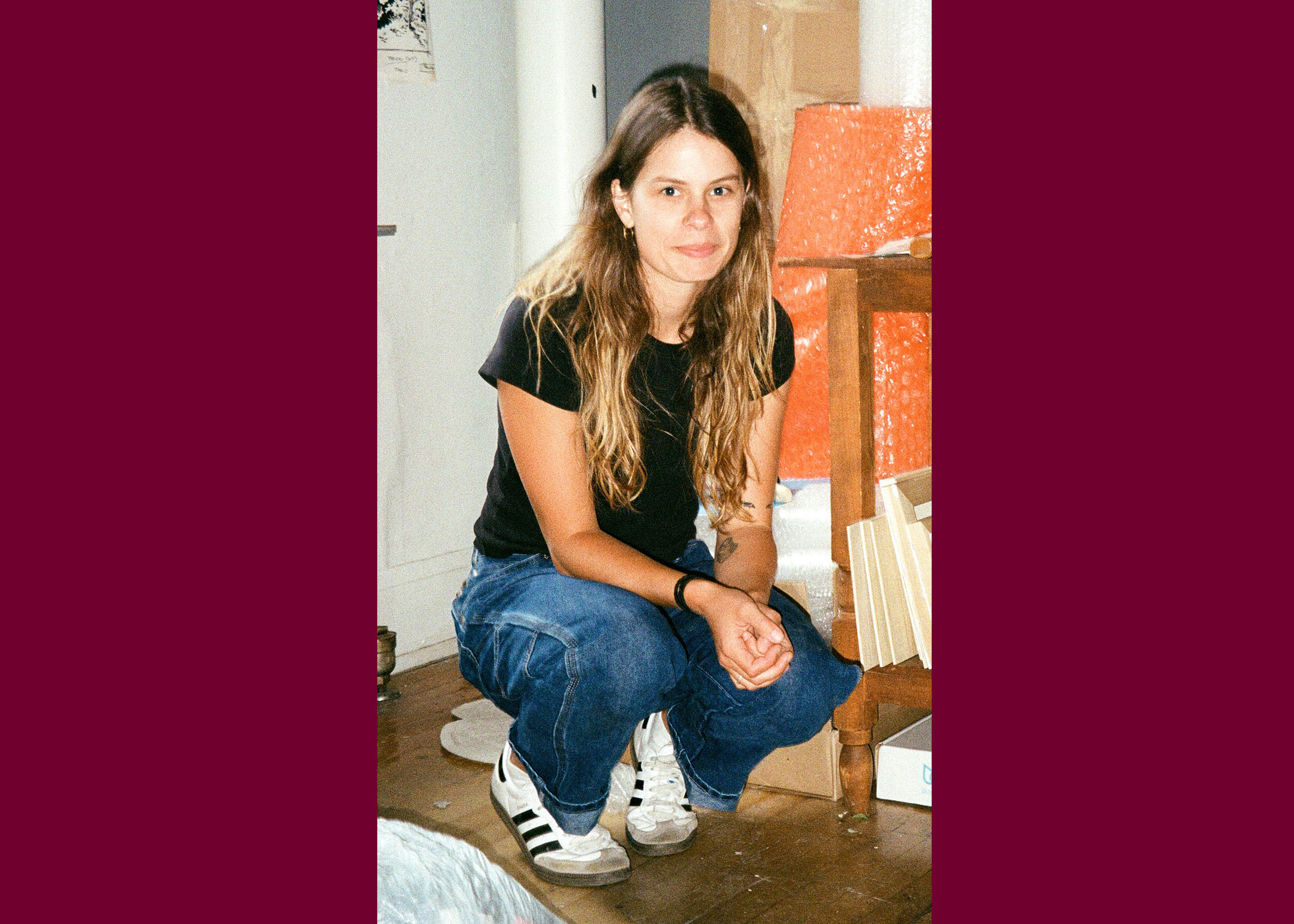
In September, Lily Kip’s paintings will appear behind broad street-facing windows in Seattle’s Pioneer Square. The exhibition space is small — more room-sized than museum-like — with only a few walls and generous windows looking out to the street. That intimacy suits Kip’s work: oil paintings of dramatic skies, figures caught in flash-lit darkness and landscapes that seem to hover at the unstable edges of day and night.
Her solo exhibition, “In Dark,” opens Sept. 3 and runs through Oct. 30 at A Gallery, 117 S. Main Street in Seattle. It brings together paintings made with support from an Elizabeth Greenshields Foundation grant and newer landscape work developed since she completed the University of Montana’s Master of Fine Arts program in 2025.
“It’s about light,” Kip says. “It’s about light and time.”
Light, in Kip’s work, isn’t just an aesthetic choice. It’s a way of thinking about the difficulty of holding anything still. A camera flash can isolate a figure while leaving the rest of the scene in mystery. Hard summer sun can make a landscape feel immediate and unreal. Clouds, which have become a recurring subject in her recent work, shift before the painter can fully understand what form they are finally settling into.
“Light is always moving; people are always moving,” Kip says. “We’re living in this world that is constantly shifting, and a painting is just one moment.”
That tension, between a moving world and the fixed rectangle of a painting, has become a signature of her work. Kip’s canvases preserve moments without claiming to settle them. A viewer sees the trace of a moment but is left to decide the before and after.
Kip grew up largely in Massachusetts, though her mother was from the West Coast. She earned a Bachelor of Arts with a double major in studio art and English. Although she studied studio art as an undergraduate, the curriculum was less studio-intensive than a BFA program. She initially expected English to be the more central part of her professional path.
“My mom is really wonderful,” Kip says. “She really saw that I was into making things and looking at things and just gave me all of the encouragement and tools that I could need.”
Kip believes that most children begin as artists – drawing, building and experimenting with their hands. What separates those who continue from those who stop, she says, is often not talent but whether they become discouraged by the gap between an imagined tree and the tree they manage to draw. Kip was fortunate: No one persuaded her that she was bad at art.
“My mom was always like, ‘wonderful, good job,’” Kip says. “I was like, ‘great, I’m the best artist in the world.’ I just kept making stuff.”
After college, however, art receded from the center of her days. Kip worked in a brewery, childcare and other service-industry jobs. During the pandemic, she stumbled into a realization: A life without making art wasn’t going to satisfy her.
“I couldn’t have a career that didn’t include art,” she says. “The thing that I realized I was missing from my life after undergrad was making art.”
She chose to pursue an MFA in part because she wanted to teach. A graduate degree could offer a path into professorship. It also could provide what she had not received in her English program: sustained time, critique and community around visual art.
Kip arrived in Missoula in 2022 and found faculty she admired, a cohort environment that challenged her and needed mentorship. Students applying to an MFA are often advised that they are not simply choosing a program, Kip says. They are choosing the people with whom they will work, the artists whose questions and sensibilities may reshape their own.
“You have basically a captive audience of peers and professors,” she says. “People who are professionals in their field — who are interested in what you’re doing — will talk to you about what you’re doing and will look at what you’re doing.”
That kind of sustained response, she argues, is difficult to find elsewhere. The MFA gave her time to make art, but also the pressure and freedom to explain it, revise it and allow others’ readings to complicate her own.
Kip entered graduate school as a landscape painter, then moved through self-portraiture before finding material in old photographs. Her thesis work centered on close friends, drawn from snapshots taken years earlier — at a river, along a road or in scenes so strange and partial that viewers could not be certain what had happened just before the moment was captured.
“The idea was that you are constructing the narrative yourself,” Kip says. “During critiques three different people would look at one painting and have a completely different idea of the narrative.”
Her undergraduate training in English literature still lingers. Kip is interested in stories that are, as she puts it, “about everything and nothing”— stories concerned with human behavior and relationships more than tidy plot. She wrote an undergraduate thesis on coming-of-age novels, and she still thinks like a reader: attentive to sequence, suggestion and what happens when images or moments are placed beside one another.
Some paintings in her grant-supported work contain three related images, perhaps seen from different angles or seconds apart. The shifts are slight but consequential. They remind viewers that a scene has no single authoritative version.
In her newer landscapes, this concern with time becomes even more evident. Kip titles many pieces with the hour and month when she took the original photograph.
“I feel like it’s the story of Montana clouds,” she says. “For me, narrative can come from just selecting things out of time and presenting them next to each other in a thought-provoking way.”
She does not typically stage her photographs. Instead, she carries a camera and observes. A friend may make a gesture that catches her attention, walk away and be asked to recreate it. A peculiar storm may inspire an impromptu trip outdoors.
“Oh, look, a weird storm,” she says. “Let’s go outside and take a picture.”
Kip once took pictures primarily with her phone, as many people of her generation do — both for memory and for the social-media record of a life. Over time, she began using a point-and-shoot film camera because it could register light in a way she found richer and more useful for painting. The photographs are increasingly made with a potential canvas in mind, but the process remains alert to accident.
Kip’s commitment to painting runs counter to the easy assumption that all images circulate equally online. A digital reproduction can show a painting’s subject, but it cannot fully convey the encounter Kip wants her work to create.
“A painting is all about the physical,” she says. “You can see the touch of the hand and you can see how big it is in relation to your own body.”
Scale changes the emotional terms of that relationship. Kip recalls an undergraduate professor saying that a painting smaller than a viewer’s head can provoke protective tenderness, while a painting larger than the viewer may create a feeling of confrontation. She has long been interested in working very small or very large, in part because each scale makes different demands of a body standing before it.
Her own relationship with oil paint developed outside conventional methods. Her first was an abstract-expressionism course, where oil paint introduced itself through movement, color and blending rather than a rigid traditional method.
“I fell in love with oil paint,” she says. “It’s just the way that it moves and the way the colors blend so well.”
Much of her knowledge has come through occasional mistakes and conversations with more technically trained peers.
“I learned a lot of it through plain experiment,” she says. “I definitely don’t oil paint correctly.”
Near the end of her MFA, Kip took a professional-development course, Beyond Art School, which introduced students to grant applications, gallery pitches, websites and the less visible mechanics of an art career. For an assignment, she applied to the Elizabeth Greenshields Foundation, a Canadian funder of representational artists, and received a $12,000 grant.
Kip received the funding shortly before her thesis exhibition, allowing her to leave graduate school with six months dedicated largely to painting. She also taught as an adjunct at UM and retained studio space on campus while developing the work. The grant supported early exhibitions in Missoula and Ellensburg, Washington, and some of that work will be included in “In Dark.”
As the funding period ended, Kip made another choice: She would stay in Missoula. She had found community there and a place she could imagine sustaining an art practice. She now manages galleries at the Zootown Arts Community Center, bringing her own experience as an emerging artist into a role that supports the work of others.
Full-time employment has made the need for her own studio time more urgent, not less.
“When I do not fit painting into my week, I am so much sadder,” Kip says. “I know that it is important to the way I process the world and linked to my mental well-being.”
After the Seattle exhibition, she plans to keep painting, begin a studio newsletter and continue approaching galleries. The future isn’t mapped, but the central commitment is clear.
“I intend to paint until I cannot hold a paintbrush,” she says.