The Forest as Collaborator
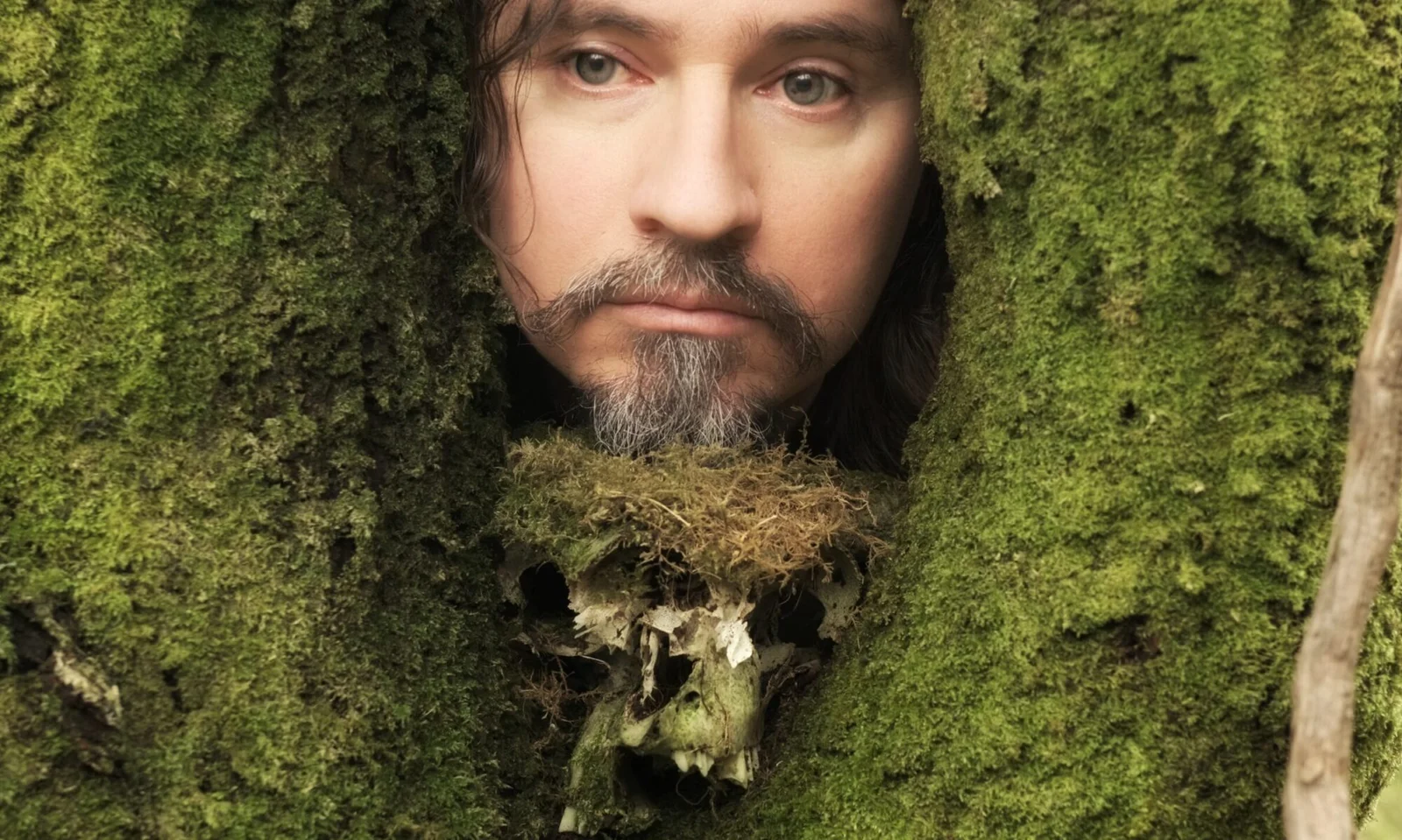
For Josh Wagner ’14, a path through writing, theater and grief led to a creative practice in the Irish woods.
On many mornings in Kenmare, a small town in southwest Ireland, Josh Wagner would eat breakfast, gather the dogs he was watching, hop a fence beside his cabin and head into the forest. There, his studio had no walls. It was made instead of moss, branches, stones and animal bones.
Wagner’s on-again, off-again undergraduate career spanned nearly two decades, culminating in 2014 after he earned an English degree with a focus on creative writing at the University of Montana. He did not set out to make the forest the center of his art after departing UM. Wagner was sure he’d become a fiction writer – after all, he’d written two novels in middle school and published a science-fiction story before leaving high school. But in Ireland, after his mother’s death in 2017, his work became more expansive: film, music, movement and sculpture with Mother Nature serving as a muse.
That practice is the subject of Wagner’s chapter, “Improvising a Forest Practice: Encounters with a Miraculous Materiality,” in the anthology “Creative and Aesthetic Ways of Grief: All Things Reimagined.” The chapter describes memorial stone circles, roadside animal burials and dressing trees with found materials. Not as symbols imposed upon the environment, but as relationships that take shape among a grieving person, a place, and the organisms already there.
Wagner grew up in Hamilton after moving to Montana from California at age 10 and first arrived at UM in 1995. Friends were there, so he followed them. He stayed a year, left, and returned to his studies periodically as life and work allowed. He began in music, moved into philosophy and initially avoided creative writing because he thought he already knew what he needed to know. Eventually, the limitations of that confidence became productive.
After completing a fantasy novel, Wagner realized that instinct and vast understanding of writing tropes had taken him only so far. Some passages sang; the rest did not, and he could not yet identify why. He returned to UM’s writing program, studying with faculty members, who he remembers as opposing but equally formative presences. From Canty came an enduring editorial principle: A writer’s task is to preserve the reader’s immersion in the imagined world. From Bass came a different, more congenial artistic sensibility.
Wagner’s creative life has never followed a single medium. He wrote novels including “Deadwind Sea” and “Smashing Laptops,” worked in independent comics and with Image Comics, helped make films and gravitated toward theater because of its communal energy. He also built a parallel career in technology, moving from tech support and Linux systems administration to Cisco engineering. Contract work gave him something rare for an aspiring artist: time.
“I could dedicate as much time as I wanted to writing and art making,” he said.
A trip to Europe after graduating changed everything. After living in Galway, Ireland, traveling to Japan for a novel set there and returning to Montana after his mother Alexis Wagner died, he eventually enrolled in a creative-writing master’s program at the University of Edinburgh. The pandemic and a cabin-sitting opportunity brought him to Kenmare. When he could not find an available creative-writing doctorate in Ireland, he redirected his theater experience into a Ph.D. in creative practice at University College Cork. The resulting research became transmedial in scope, incorporating artistic forms he had not previously considered central to his work.
The catalyst was grief. Wagner’s mother, a family nurse practitioner in Hamilton and an early advocate for his life in the arts, had combined clinical steadiness with a tender bedside manner, he said. After her death, Wagner began raising standing stones at sites in Montana, England and Ireland. In the anthology chapter, he writes about the way those memorials grew into an evolving practice: an attempt not to “move on” from loss, but to remain alert to change, decay, matter and the living systems through which a person’s memory continues to reverberate.
Wagner’s art challenges the notion that human beings sit at the center of meaning. In the forest, he has sought to treat nature not as a mirror for human feeling or backdrop for artistic endeavors, but as an equal participant in its making. A skull placed on a branch might fall in the wind. Moss might cover it. Insects might transform the material. Such events, he writes, are not interruptions to the work – they are part of it.
One account in the chapter returns to a stone circle on his mother’s Montana property, where Wagner observed burying beetles busy at work on the corpse of a field mouse. The encounters resisted a neat narrative. It was a biological process that still could be met with artistic belief. Moments where grief, ecology, chance and intention all intersect.
Wagner’s work doesn’t ask grief to resolve into recovery. Instead, it asks what might be learned by staying with grief’s strangeness and its power to make the familiar feel inadequate. The forest, in this sense, offers both material evidence of mortality and an alternative to isolation. It’s a world of interdependence, transformation and continuing relation.
“Rather than avoiding or shutting down to what feels abject and uncanny in death and in grief, suppose we opened ourselves to the spectral qualities of shared living and dying?” Wagner questions in his chapter.
These days, Wagner still writes and teaches, including courses through the Irish Writers Centre and Cork libraries. He is also working on comics and short fiction. But music, especially composing for film, has become his current passion.
Wagner resists treating art as a luxury to be pursued only after more practical obligations are met. For him, difficult art is a form of ethical reckoning — a way to face the complicity, damage and ecological precarity embedded in ordinary life. The woods near Kenmare have become one setting for that reckoning: a place where grief is not merely endured but paid attention to.
“Grief is an anomaly, and we want to recover from it – we want to come back,” he said. “I was asking myself, do I have to do that? Do I have to come back?”