Iryna Chaika: Building bridges, then and now
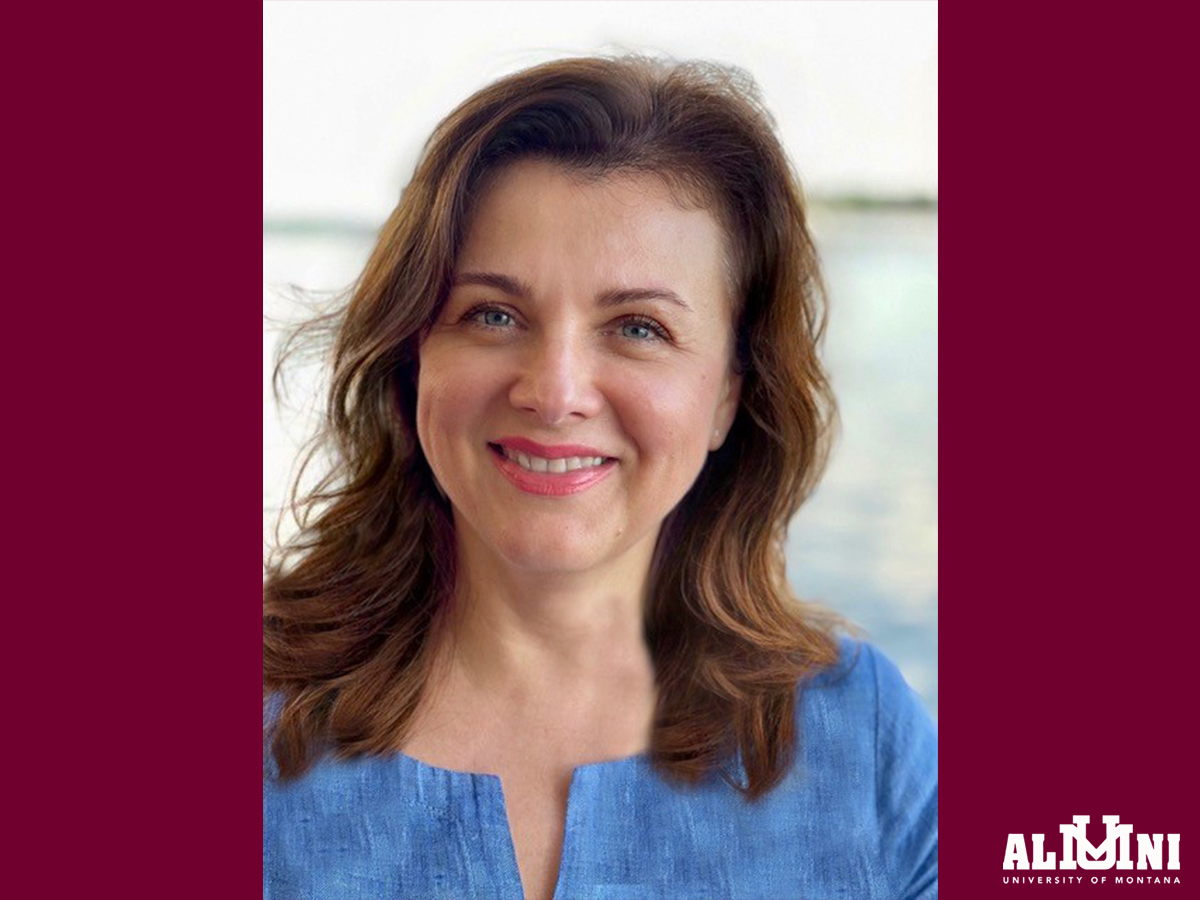
Iryna Chaika came to the University of Montana in 1991 as a Soviet student who had never heard of rafting.
She left UM with a new way of seeing the world.
She arrived in Missoula at a moment when history was shifting beneath her feet. Ukraine declared independence the same day she landed in the United States, and the country she had left was already beginning to disappear. In Montana, she found something else taking shape: a life defined by curiosity.
“The doors just opened,” Chaika said of that year. It was, she added, “the best year of my life, at that time” — the one that divided everything into before and after.
More than three decades later, Chaika still works at the boundary between two countries. As program manager at the U.S.-Ukraine Business Council in Washington, D.C., she helps bring American and Ukrainian companies together, organize high-level events and strengthen the commercial ties that now matter as much to Ukraine’s future as any diplomatic gesture.
It seems to complete a circle that began in Missoula.
Chaika said her year at UM taught her not simply how the U.S. worked, but how to move through the world with a different set of instincts. She said yes to nearly everything. When a student on her dorm floor invited her rafting, she accepted before asking what rafting was.
“Every time when somebody offered me something,” she said, “I would say yes, and then I would check later what that is.”
That small habit, repeated over and over, became her doorway into adventure. It led her into campus life, into a host family’s home, into new friendships and to experiences she could not have predicted when she left Kyiv. A campus job taught her how customer service worked. The office for foreign students helped make Montana more familiar. Mentors, including faculty adviser Dr. Robert Hausmann, gave her steadiness. The University itself, she said, gave her room to discover how much she could absorb from the world around her.
What she learned in those months was not confined to classrooms. It was a practical education in how people live, work and trust one another. She came from a Soviet system in which the U.S. had once been cast as an enemy, but found herself in a place where strangers invited her to go rafting. She began to understand that the deepest connections between countries are made through people.
That insight became a through line in her career.
After returning to Ukraine, Chaika completed her degree in foreign languages, then later earned a master’s degree in public administration at New York University through a Edmund S. Muskie Fellowship. She eventually added an MBA in Kyiv. Her career moved across sectors and disciplines: municipal development, information technology, telecommunications, pharmaceuticals, business consulting. At every stage, she developed the same skill she first honed in Montana: an ability to translate between systems.
In the 1990s, she worked on the U.S. Agency for International Development-funded municipal development projects in Ukraine, helping local governments prepare budgets, improve planning and strengthen capacity. Later, she moved into marketing and business development in the private sector, including a long tenure at Ukrtelecom, where she led marketing communications and public relations. She went on to serve as managing director of a pharmaceutical company before the current war upended her plans.
Her resume reads like the story of a country in transition. Chaika moved between public and private sectors, between local and international contexts, and between technical work and relationship-building. She learned how to work in fast-changing environments, how to manage teams, how to negotiate and how to adapt. Those qualities, she said, were already present in the student she had been in Missoula, even if she did not yet know where they would lead.
The war changed everything again.
When Russia launched its full-scale invasion of Ukraine, Chaika and her son eventually came to the U.S. through the Uniting for Ukraine program in 2022. She had spent the first months of the war in Ukraine, where the violence was immediate and personal. When she began looking for work in the U.S., she wanted something that would use not just her resume, but her whole life.
At the business council, she found it.
“It’s a great combination,” she said. “It’s the essence of everything I know I can do.”
Her job brings her into contact with large American corporations, Ukrainian businesses and the kinds of conversations that can shape investment, reconstruction and long-term partnership. From the outside, the work can seem technical. But Chaika sees it in human terms.
“It’s not just something that you just enjoy,” she said. “It brings a lot of benefits to both countries.”
That, perhaps, is the most UM part of her story: the belief that one person, paying attention, can make connections that last.
UM introduced Chaika to America, but it also gave her a template for how to live inside a larger world — one in which curiosity can become courage and openness can become a career. She came to Montana as a young woman amid global change eager to understand what lay beyond the Iron Curtain. She left with a vocation, though it took years to name it.
Today, she helps Americans and Ukrainians understand one another a little better and helps turn that understanding into action. The bridge she began building in Missoula has carried her far beyond campus, across industries and across continents. It still feels like she’s standing where she stood in 1991: at the edge of something new, saying yes.