In 48 Hours, a UM Alum Made a Winner
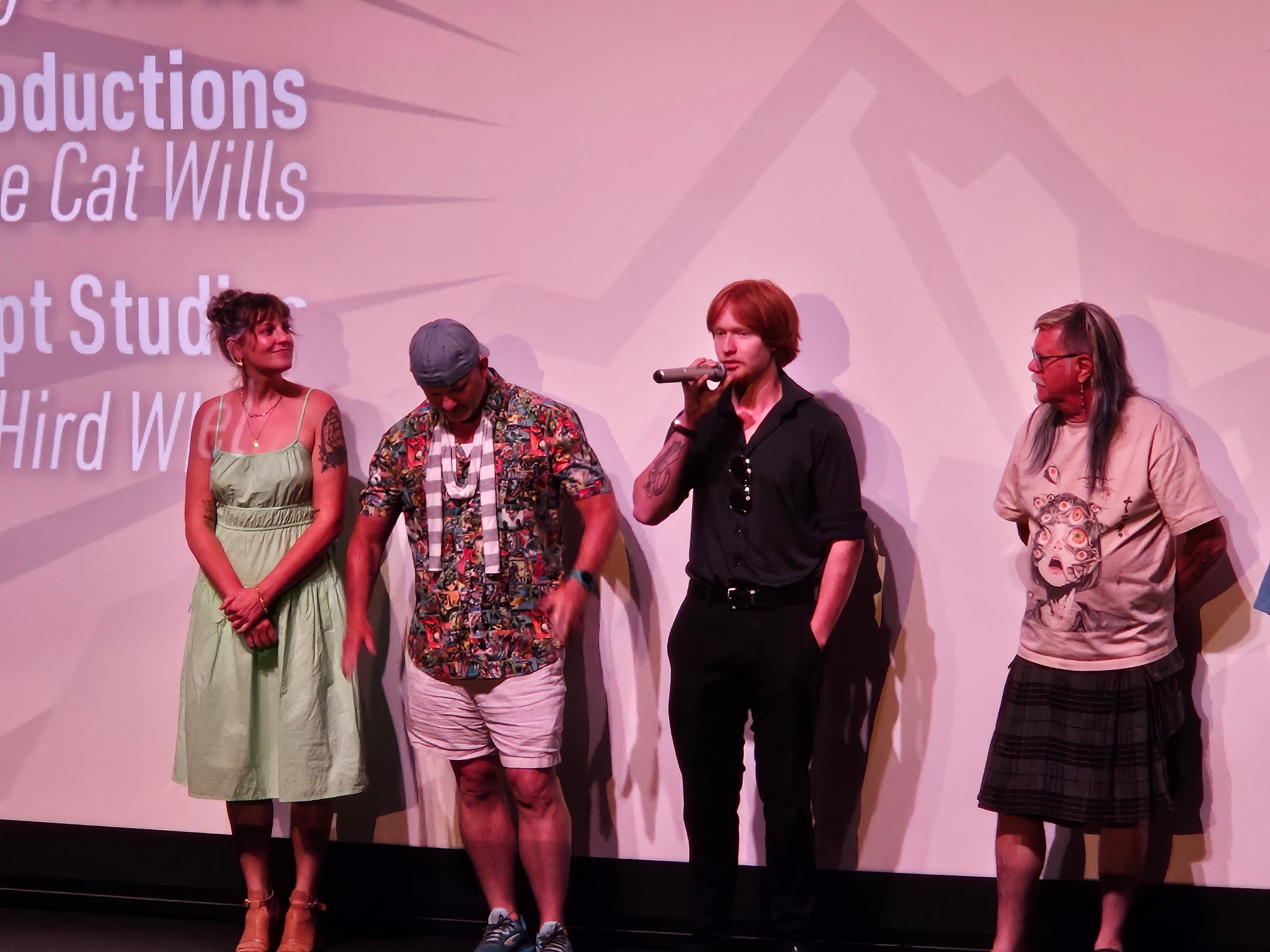
Before he was running on no sleep and making movies about murderous doubles, Chris Shields ’25 was an East Helena kid with a taste for film and a knack for stories. At the University of Montana, he arrived as a journalism major, wrote movie reviews for the Montana Kaimin and learned the essentials of visual storytelling through the School of Journalism. But the pull of narrative filmmaking was too strong to ignore. He added a media arts degree in digital filmmaking.
The double major makes sense once you meet the work: Shields has a reporter’s appetite for the raw moment and a filmmaker’s instinct for the well-composed shot. For “Dead Ringer,” his horror-comedy entry in the Montana 48 Hour Film Project, he was director, cinematographer, gaffer and colorist — a four-job title that indicates either ambition or a masochistic lack of self-preservation. The result took first place and Audience Favorite, making Shields and his Slop Shop Production outfit the first UM-connected team to win the competition’s top honor.
Next up is a different kind of mayhem: a feature-length mockumentary about professional sledding, a sport that Shields notes does not exist. The film, “The Fastest Way Down” — created with collaborators from Slop Shop Productions and featuring help from Missoula and UM creatives — has been in the works for more than a year. The plan is to launch its “Sled Around the World” tour with a Missoula premiere on Sept. 11 at the Roxy Theater before taking it to Los Angeles and Austin, Texas. Expect ski-movie bravado, gratuitous blood and guts, and the dead-serious treatment of an entirely invented athletic pursuit.
UM Alumni Association: For anyone who’s not familiar,what is the 48 Hour Film Project competition?
Chris Shields: It’s exactly how it sounds. You have 48 hours to make a movie, essentially.
Every other team registered in Montana gets on the same Zoom call on Friday night. They go over the rules, and everybody is given the same character with a profession, a line of dialogue and a prop. Then every team spins a wheel to get the genre for its movie.
As soon as you get your genre, the clock starts. You have 48 hours to make a movie between four and seven minutes long that incorporates a line of dialogue, prop and character within your genre. You have to write, shoot, edit and turn in a polished short film before the time is up.
It’s a crazy, stressful weekend of very little sleep and very little food. This was the first year that I literally did not sleep a wink for 48 hours straight. My body hated me for a couple of weeks after that, but it paid off.
UMAA: You participated in previous years. What was the mindset going in this year?
Shields: I actually wasn’t planning on doing it this year. I got roped into it my first year by some fellow media arts friends. We thought it sounded like a crazy, silly, stressful weekend but figured we could do it once, say we did it and move on.
But our first year, we had so much fun. It was stressful and such a time crunch, but we made a pretty good little short film and won third place. For some college kids who had never really made a film project before, that was humbling — but also very enticing. I thought, if we could do this with a six-person crew, competing against teams from all over the state, imagine what we could do with more experience, more crew, a bigger cast and more knowledge.
I kept getting pulled back into it. This year, I put my foot down. I said, “I’m not doing it. It is so stressful, and I feel like every year I’m doing it, I take more years off my life from not sleeping for 48 hours straight.”
Then three different actors texted within a few hours of each other, asking if I was competing and if they could be part of my team. One of the co-directors of the Montana 48 Hour Film Project reached out and asked if I would compete. I thought, “Well, this looks like I’m pulled back into it. There’s a sign.”
At our first production meeting, I told everybody: “This year, we’re winning, because I’m tired of doing this project. If I win, then I never have to do it again. None of us do.” We were taking first place. There were no ifs, ands or buts about it.
We stuck strictly to that plan. We were right on schedule, if not ahead of schedule, and ended up being the first team in the state to turn in our project — about three and a half hours early. This year had a record 19 teams competing from all corners of Montana. We ended up walking away with Audience Favorite and first place. We’re the first University of Montana team to ever do so, and we’re very proud of that.
UMAA: Now that we’ve established the stakes, let’s talk about “Dead Ringer.” What is it?
Shields: “Dead Ringer” was written by a couple of friends of mine, Jake Howell and Isaiah Hesford. The three of us have been longtime collaborators and really good friends for several years. We used to do stand-up comedy around Missoula, and we all have the same sense of humor. We decided to start making sketch-comedy stuff for Instagram and YouTube.
At one point, somebody spitballed the idea that it would be really fun to work with a clone. We never did anything with it, but then we were in the writers’ room for this 48 Hour Film Project and drew horror as our genre. We thought: This would be a perfect opportunity to do something with a clone — make it scary and silly, because comedy is what we do.
The character everyone in Montana was given this year was a janitor, and our line of dialogue was, “Please don’t freak out over this.:” So, we had to work a janitor and that line into a horror script.
The plot is about a janitor who is kind of an introvert and a dork. He’s moving in with a new roommate, and it’s his first night there. His roommate invites a bunch of friends over, including her new boyfriend, who happens to be an identical clone of our main character. He’s the only one who can see it. Nobody else gets it.
The new guy isn’t just a clone — he’s a better version of our main character in every single way. He’s charming and good-looking, even though he’s the same guy. Everybody falls in love with this new boyfriend and rejects our main character. It goes off the rails from there.
Our lead actor got to play two versions of himself, which was really fun. He ended up winning the Best Actor in Montana award.
UMAA: What were some of the biggest challenges with this project?
Shields: It’s always the deadline. Forty-eight hours is a really quick turnaround for anything, but especially for a movie. These things usually take months, if not years, to see their fruition.
Friday night, we got our prompts and wrote the script. Then, as soon as we had it written, we went out and shot as much as we could into Saturday morning. We spent Saturday shooting or editing, went back out Saturday night, shot some more, came back and finished the edit by early Sunday morning. Then I started color-grading the footage, we passed the audio off to our audio mixer for a final pass, assembled everything and turned it in Sunday evening.
There was no rest. We were full grind, full send the entire weekend.
The editor, Hesford, and I slept very little, if at all. But other than that, things ran pretty smoothly. This group is a well-oiled machine when we get into it. We’ve all worked together several times before on a variety of projects. Even though we’re tired and hungry and might snap at each other every now and then, we all know it comes from a place of love. We’re all in this to win this, and we come together in the end and make it work.
UMAA: Looking back at the film, are there any moments or techniques that you all did that you were especially proud of? I know it’s easy to be nitpicky when working in the arts.
Shields: I’m a director and cinematographer by trade. I direct actors and scenes, but I also do the camera work and try to make everything look beautiful. It’s a double-edged sword, because I want to direct and shoot my own movies, so I have complete control over the visual side of things. But shooting means less time to direct, and directing means less time to compose shots.
This time around, we couldn’t find anybody to do lighting. So, I thought, “Screw it. I’m going to have to teach myself how to do lighting.”
In the weeks before the project, I watched a lot of YouTube videos, researched and practiced. Then we were thrown into a location I was unfamiliar with, with a story none of us had worked on before. I was directing the actors, setting up the camera and moving all the lights around on my own. I was certain it would look terrible because I was an amateur gaffer juggling so many things.
But when I got to the edit — and especially the color grade — I thought, “For a guy who’s never done lights before, this looks not half bad.”
We were nominated for Best Cinematography. We didn’t win it, but that’s almost one of the awards I’m most proud of, because I got to really experiment and learn on the day. Your practice is also your first take. You have to record everything because you don’t have the time to spare.
Hearing people after the screening at the Myrna Loy talk about how much they loved the visuals, mood and lighting — that was a pat-myself-on-the-back moment.
UMAA: I want to rewind the conversation a bit to Slop Shop Productions. I’m curious about the inception of that.
Shields: Slop Shop Productions is my friends Howell, Hesford and me. I met them while shooting a documentary project a few years ago. They were involved in music and trying to get into film, but didn’t really have the know-how. I said, “I have know-how; I need ideas to make.” They said, “That’s perfect, because we’re ideas guys.”
We started hanging out, laughing and making little comedy things.
We started small and worked our way up. We decided that, if we were going to keep doing this, we should put a label on it — not because it was going to be a household name, but so people who cared could know these are the guys behind what they’re watching.
We went through a lot of stupid, silly names. I came up with Slop Shop Productions.
UMAA: How does your work in nonfiction — in documentary and journalism — affect your approach to fiction, and vice versa?
Shields: Documentary and narrative filmmaking are fundamentally different in a lot of ways, but they really aren’t. It’s the same medium. We’re telling a story on camera; it’s just a matter of how true it is.
What it comes down to is: Is the story interesting? Am I entertained? Can I connect with this person or story emotionally on a more intimate level?
I hold a lot of weight to the journalistic values and integrity I was taught at the J-school. In my documentary filmmaking, I try to interfere with the process as little as possible. I’m very into cinéma vérité filmmaking, which is how I’m shooting a documentary about the local Missoula band Senterline. There are no sit-down interviews or scripted conversations. I’m just there in the corner of the room with my camera, capturing raw moments.
I think a lot of documentary work isn’t as true to the story as we would like to believe. There are scripted moments or things cut around in editing. Somebody can say a quote or line, and it can be edited to mean something different or not get the full point across. I try to steer away from that as much as possible. I’m not there to judge. I’m there to tell the truest story that I can.
In narrative filmmaking, there’s always a theme or message, and the film grammar informs that theme. But even then, actors’ decisions and performances can completely change a project. You’re along for the ride. Hopefully, you clicked record on the camera.
UMAA: Why do you think preserving a local art scene is so important?
Shields: That question goes right down to my soul. Making art and working with people is how I relax. I wake up, edit, go to my day job, come home and edit until I go to bed. I do that every day because I care so much about putting things out there and keeping the art scene lively and ever-changing, even if it’s local.
I don’t fit into one box. In the same month, I can be finishing a dark drama short film, making a horror-comedy short, editing a documentary and beginning preproduction on a music video. That satisfies my creative brain.
At the end of the day, it’s what I want to leave with the world. I’m just trying to build up my obituary before I have to use it. I think that’s what every creative in history is doing. If you care enough about the craft, you keep doing it.
The film scene couldn’t exist in its current state without the music scene, graphic design scene and all the other art scenes feeding off one another. A lot of people work across disciplines: They’re musicians and filmmakers, photographers or painters. That’s what makes Missoula special to me.
You can’t do anything alone. If you put yourself out there, keep making things and collaborate with people, that’s the key to a happy life in my mind.