Bearing Witness: Brontë Wittpenn’s Road to the Pulitzer
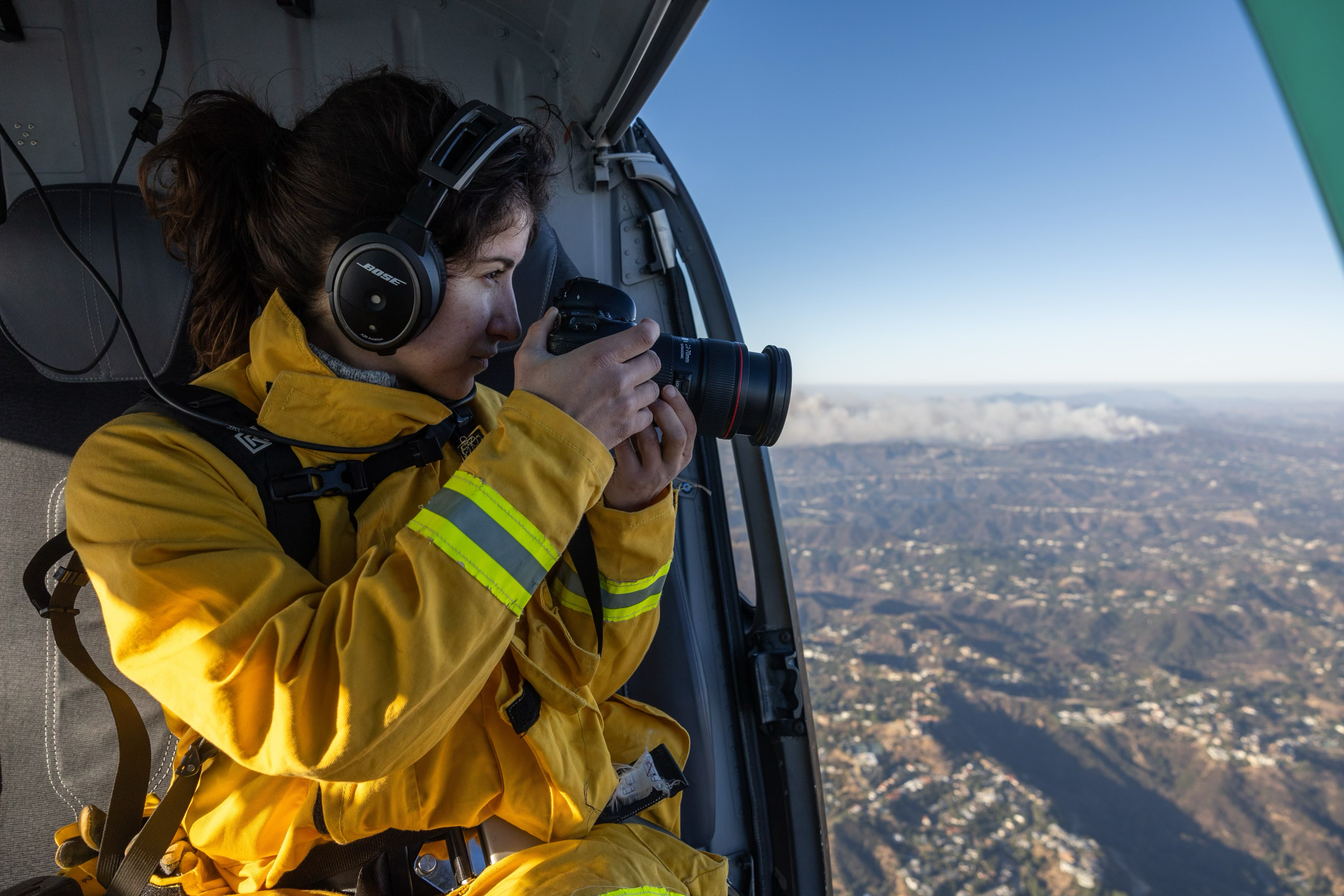
On a spring afternoon in San Francisco surrounded by peers, Brontë Wittpenn entered a small and uncommon circle: University of Montana journalism alumni who have helped carry a project to journalism’s highest rung – the Pulitzer Prize.
The San Francisco Chronicle’s prize for explanatory reporting went to reporters Susie Neilson, Megan Fan Munce and Sara DiNatale, but Wittpenn produced the visuals and short film for “Burned,” the investigation into how wildfire survivors can be left adrift by the insurance system meant to protect them.
In a prize created by Joseph Pulitzer to reward “the most disinterested and meritorious public service,” the Chronicle’s first Pulitzer in 20 years felt like a new beginning.
The long way to Missoula
Wittpenn didn’t arrive at the University of Montana with a clear vision. She arrived with a belief that she was better at talking to people than she was at being a student.
Wittpenn grew up in Billings, where she spent a brief stint on the high school newspaper at Billings Senior High School and struggled to find her footing in the classroom.
“I wasn’t the best student,” she said. “I really struggled to find what I was good at.”
She knew she could write. She knew she had an artist’s eye. But she also knew she was being told, repeatedly, that those strengths wouldn’t pay the bills.
What she discovered, instead, was that journalism gave her a way to tap into those talents. Working in restaurants while in school, she learned to talk to people from every walk of life. That ability to ask questions without flinching, to meet people in their hardest moments without turning away, became her guiding principle.
Wittpenn heard there was a journalism school in Missoula, and that was enough to start exploring.
“I didn’t really know what specifically I wanted to do in journalism school,” she said. “I always had a pretty complicated relationship with schooling as a student.”
In the School of Journalism, Wittpenn was not the student with the most technical polish.
“I wasn’t a great photographer,” She said. “I didn’t really have that ‘it factor’ like some other students going through the program.”
But she had something else: grit and an instinct for finding stories in places other people overlooked. She traveled across Montana to cover Native American reservations, veterans, unhoused neighbors and the communities that made the state feel singular.
“I was never really shying away from the people and the places and the spaces that make Missoula and really Montana a special place and a unique place,” she said.
The years in Missoula were also complicated in ways that had little to do with grades. She worked late shifts at bars and restaurants, sometimes coming home near the witching hour and then driving to Heart Butte on the Blackfeet Reservation the next morning to shoot a story she had pitched for a documentary class.
“I literally had like two or three hours of sleep and having to bomb up there,” she said. “It was just really intense for me often.”
Personal losses stacked up, too. Her stepbrother died in a drunk-driving crash while she was in school. A friend nearly lost her life in a rock-climbing accident.
The grind was exhausting. It was also, in retrospect, preparation.
“That grind really prepared me for the actual realities of what this job entails,” she said — the running and gunning, the pivoting, the adapting.
By the time she graduated in 2016, Wittpenn left Missoula with a degree, a portfolio and a sense that she was ready to see what the rest of the country looked like through a lens.
From Billings to Flint, then to the front lines
After graduation, Wittpenn took an internship at her hometown paper, the Billings Gazette, which turned into her first staff job. Reporting in Billings was inestimable, she said, but also complicated. She was seeing her own city with new eyes — its population, its tensions, its contradictions — and that intimacy was not always easy to carry.
Two years in, she attended her first photojournalism workshop in Colorado and came away changed.
“I was just absolutely floored,” she said. “I was so inspired. I was meeting photojournalists, young, older, from all over the country.”
She realized how much she still had to learn and how much of that learning would have to happen somewhere else. “I need to leave Montana,” she thought. And she did.
In a move she does not recommend to students, Wittpenn took a leap of faith. She quit her staff job to take a six-month internship at the Flint Journal in Michigan. She went from modest staff pay and benefits to even less money and no benefits at all.
“Honestly, it was the best decision I ever made,” she said. Flint put her in a community she had never lived in, with stories she could not have found in Montana. Under the mentorship of photographer Jake May, she grew quickly, even as the work tested her.
“It was painful and it was challenging and I questioned it every day,” she said. “But I also started to really grow up as a photojournalist.”
There was one assignment in Flint that cemented what good journalism could be. The city’s water crisis, which began in 2014, was still unfolding. Residents lined up for hours in their vehicles to collect cases of bottled water distributed by the city. Wittpenn’s job was to photograph the lines and talk to the people in them. She met an older man waiting in line with cases of water for his elderly mother, who needed full-time care. He agreed to let her come to their home to document how they used the bottled water.
What she found there stayed with her. The man’s back patio was stacked with plastic bottles. His hands were callused from opening them multiple times a day. Inside, his mother — a woman with COPD whose skin broke out in sores from the harsh tap water — welcomed Wittpenn into her bedroom, which was covered in horse posters. The woman explained that even washing her hair required bottled water. Wittpenn photographed the son gently sponge-bathing his mother, and then, with some difficulty, the woman showed her the sores that covered her arms, hands and chest.
“It was a really hard image because she did get emotional while showing me this,” Wittpenn said. But it was also the moment she knew that she was meant to do this work. “I’m meant to be here,” she thought. “I’m meant to photograph, through this like really beautiful collaborative process, me and her, what people should see.”
From Flint, Wittpenn moved on to an internship at the Tampa Bay Times, where she covered Category 5 hurricanes and protests. She took more risks: a stint in the Middle East and a staff position in Austin, Texas. In 2021, she joined the San Francisco Chronicle, her longest staff job to date.
California arrived turbulent and demanding. The state was still reckoning with the pandemic, the George Floyd protests and a rapidly changing climate. The Chronicle had built a legacy covering wildfires, and Wittpenn knew that would be part of her work. Months after she started, the Caldor Fire erupted, jumping from the Sierra into the Lake Tahoe Basin and forcing evacuations of 50,000 people. She covered the fire alongside veteran photographer Carlos Avila Gonzalez, learning in real time how to work safely while making images that mattered.
While much of the media attention focused on South Lake Tahoe, Wittpenn kept hearing about a smaller logging community nearby that suffered heavy damage but received little coverage: Grizzly Flats. She shifted her reporting, searched for displaced residents on social media, spent time in local businesses and built trust with people who had lost their homes. Those relationships became the foundation of the Chronicle’s defining visual coverage of the fire — and, years later, the groundwork for the “Burned” investigation into underinsurance.
“Those relationships I was able to form years later would become foundational in the Chronicle’s investigation on California’s insurance crisis,” Wittpenn said. “They remembered me. They remembered the care and respect I had while taking in one of the most difficult moments in their history.”
That trust allowed the newsroom to return with deeper reporting on the long-term consequences of underinsurance and prepared her for the next defining disaster: the 2025 Los Angeles fires.
Out of the fire
The Pulitzer-winning “Burned” series began as a question about why so many communities couldn’t rebuild after catastrophe became a sweeping investigation into how major insurers left homeowners undercovered, underpaid and, in too many cases, unable to return home.
The reporting began, Wittpenn said, when Chronicle journalists Susie Neilson, Sara DiNatale and Megan Fan Munce noticed a pattern stretching beyond California. As they tracked the devastation of floods and hurricanes in the Carolinas and similar losses in Florida, they began asking why recovery so often stalled after the cameras left and the news cycle moved on. That inquiry led them West, to California fire country and eventually to Grizzly Flats, the mountain community destroyed by the Caldor Fire in 2021.
Wittpenn arrived with an unusual kind of memory already in place. One of the people at the center of the story was someone she had photographed in the fire’s aftermath.
“It’s crazy because one of their sources in the story was someone that I had actually photographed who lost their home in 2021,” she said. “When it came across my desk, I was like, oh, I already know who these people are.”
She had documented them in one of the darkest moments of their lives. Returning years later, she found that the damage had deepened.
What she saw in Grizzly Flats was sobering. Many residents still hadn’t been able to rebuild. Some could not afford to put homes back on the land where they had lived; others were living in trailers.
“I couldn’t believe what I saw,” Wittpenn said. “There were for sale signs everywhere. And then also people were living in trailers.” For families who had spent years saving for the dream of mountain life, the fire had become something more devastating than loss. It had become an unfinished sentence.
At the center of “Burned” was a contradiction that seemed abstract until the Chronicle rendered it visible. Homeowners had paid premiums for years — often punishingly high ones — and still found themselves stranded when disaster struck. “You kind of assume like you pay these premiums, these massive premiums,” Wittpenn said. “And then, when your biggest asset’s destroyed, you kind of think, oh, but I’m okay.” Instead, the reporting exposed a system designed to frustrate that belief: hidden rules, opaque calculations and claims processes that left survivors fighting for coverage they thought they had already bought.
Then the story changed again. Six months into the investigation, the Eaton and Palisades fires erupted in Los Angeles County, forcing the Chronicle to expand the project in real time. Wittpenn found herself balancing, as she put it, “the long arc of investigative reporting” with “the urgency of breaking news,” flying south to cover the fires while still searching for new voices to include. Halfway through the documentary, her editors asked her to rework the opening so it began with L.A. “You have to completely change your documentary,” she recalled. “We need it to open with L.A.” Months of work had to yield to the story as it was actually unfolding.
That disruption sharpened the piece. As the team became fluent in the hidden mechanics of insurance, the new fires made the stakes visible on a much larger canvas. Wittpenn said it is “really hard to visualize insurance,” but the project succeeded by giving the subject a human face. It showed not just policies and payouts, but the people trapped inside the web — households pushed into crisis when the coverage they trusted turned out to be far thinner than they had been led to believe.
When the Pulitzer was announced, Wittpenn said her thoughts went first to the people whose losses had animated the series from the start. ”They lose their home,” she said. “Then they’re told they all have enough money to rebuild.” Instead, they faced forms, denials and setbacks. For Wittpenn, the award confirmed what the reporting had shown all along: “There is something wrong and it’s not them.”
The celebration carried a significance beyond the prize itself. The Chronicle had not won a Pulitzer in two decades, and the newsroom watch party gave the moment a rare mix of intimacy and history. Wittpenn said it was “so cool to be a part of history like that,” a recognition of the patience, collaboration and sheer endurance required to make work of this scale.
What Wittpenn seemed most grateful for was not the distinction, but the chance to help expose a system that had hidden in plain sight.
“These insurance companies can’t hide from this now,” she said. “We exposed injustice. And now, there is evidence out there that proves that.”
On staying, on balance, on what comes next
The question lands with a crashing force: What has working in journalism revealed about who you are as a person?
Wittpenn takes a moment. “I think I have a lot more courage than I thought,” she says finally. “It takes a lot of courage to keep showing up in this industry. It takes a lot of courage to make that decision to stay in this.”
The industry is changing fast, she notes, and not always in ways that make it easy to remain.
Still, she stays. Partly because the work itself — the people, the stories — keeps pulling her back. “Just like the people in the stories that I cover, I think it can be really easy to get in this headspace of robotic way of being a journalist,” she says. “But the people that I work with, the people in the stories, they remind me that I’m still here, I bring a lot of humanity and depth and nuance to how I do my job and how I hone in on my craft. It’s a gift. It’s a gift to be able to stay in it as long as I have.”
Why stay at all, given the cost? Sometimes, she admits, it doesn’t feel worth it. “It would be way easier to just go work in tech,” she says, laughing a little. “Or a job that actually pays my worth.” But then she thinks about what would be lost if more journalists walked away. “That’s literally what the forces that, the systems that work to silence us want. And when I say us, like journalism, journalists, watchdogs of society, that’s what they want.” She worries about a future where corporate interests consolidate newsrooms and deepen inequality in coverage.
“I know that would be more convenient for those in power,” she says. “I don’t want that and so I’m going to try to stay in it as long as I can. But I also want to know when it’s time to walk away.”
The conversation became a chance to reflect on her time in school. She wishes she had been more willing to admit what she did not know — how to find a story, how to use her camera, how to navigate the expectations of a demanding field.
“I wish I would have just been more vulnerable about it instead of trying to just keep up,” she says. “I think had I been more willing to do that, maybe I would have found my path a lot sooner.” She also wishes she had given herself more room to play. “I wish I would have had more fun with it, if that makes sense.”
In the last couple of years, she says, she realized she couldn’t put all her worth into her job. “It’s like an abusive relationship,” she says. “I can’t put all my worth in this.” She had been crushing herself over every missed story, every lukewarm response from an editor. “If I didn’t get that story or if I wasn’t consistently making good work all the time, it just crushed me.” She started saying no more often, rebuilding a relationship with herself outside the newsroom. “I always fall back on fitness when things get hard.” She runs ultra-marathons, stays active in her running community, spends time with her dog and leans on family and friends. “You cannot put your whole entire worth in this career,” she says. “Journalism cannot be what fills your cup. It can’t be the only thing. It just cannot.”
For young journalists trying to break in, that balance is hard to find. “You do have to grind,” she says. But she warns against letting the grind become the whole story. “You need to be a whole person outside of journalism,” she says. “You need to have other things that fill your cup, whether it’s running a race, being part of a dance community, climbing a peak, floating a river, reading an entire weekend, calling relatives you haven’t talked to in a while. You just have to have that balance or else you’re going to burn out.”
One place where she tries to pass that lesson on is back to the Garden City. For the past three years, Wittpenn has returned to the UM School of Journalism to help lead the Montana Photo Workshop, an intensive program for college student photojournalists and early-career photographers. Now in its third year, the workshop brings together a small cohort — 16 to 20 students — with a team of instructors for four days of real-world reporting, editing and critique in the greater Missoula community. Participants work in teams to cover local stories, receive mentorship from seasoned visual journalists and present their work at a public celebration on the final day.
This year’s workshop runs Wednesday, Sept. 9, through Sunday, Sept. 13, with an opening reception on Wednesday evening and a public showcase on Sunday afternoon. Instructors include Tamir Kalifa, a freelance photojournalist and the workshop’s keynote speaker; Stacy Revere of Getty Images; freelancer Tailyr Irvine, John Locher of the Associated Press, Bruce Ely of the Portland Trail Blazers, Tommy Martino of the University of Montana, Lisa Krantz and Jeremy Lurgio of the School of Journalism, and Wittpenn.
For Wittpenn, the workshop is also a way to give back to the place that helped shape her. She remembers how long it took to find her footing, how much she wished she had asked for help sooner, how much she learned by doing and by failing. “It’s a gift to be able to stay in it as long as I have,” she says. Part of that gift, she has decided, is making sure the next generation does not have to navigate the field alone.
When the conversation turns to misconceptions about her work, she is quick to name one: that visual journalists are just photographers or videographers, not reporters. “We are journalists too,” she says. “A lot of the times we’re the only ones out in the field. A lot of the times we’re the only ones finding sources and really making big issues human.” She thinks of the insurance series again. “Why would anyone care about an insurance story if you don’t see the people that are living with the consequences of underinsurance? And you hear their voice and you see their faces.”
She is also frustrated by the erosion of trust in media and the rise of voices that do not adhere to journalistic ethics. “Everyone thinks they’re a journalist or an expert now, and it’s really tough to deal with that,” she says. “A lot of people feel like they can’t trust media.”
She knows the industry has work to do to rebuild that trust, but she also knows that good journalism still exists — and that it requires investment. “How do you expect good journalism to happen if you’re not going to invest in it?” she asks. “All these layoffs and corporations buying into journalism and laying off staffs and cutting budgets. How do you expect coverage on ICE and coverage on police brutality to be robust and be good if we’re not investing in journalists of color and investing in their careers and keeping them?”
Journalism isn’t dying, she insists. It’s in a state of metamorphosis. But the change isn’t cost-free. “It’s tough,” she says. “That just means we have a lot of work to do to rebuild trust with communities.” For her, that work starts with the people in front of the lens and the students behind it. It starts with showing up, even when it is hard.