Amy Allison turns a passion for service into a career of community care
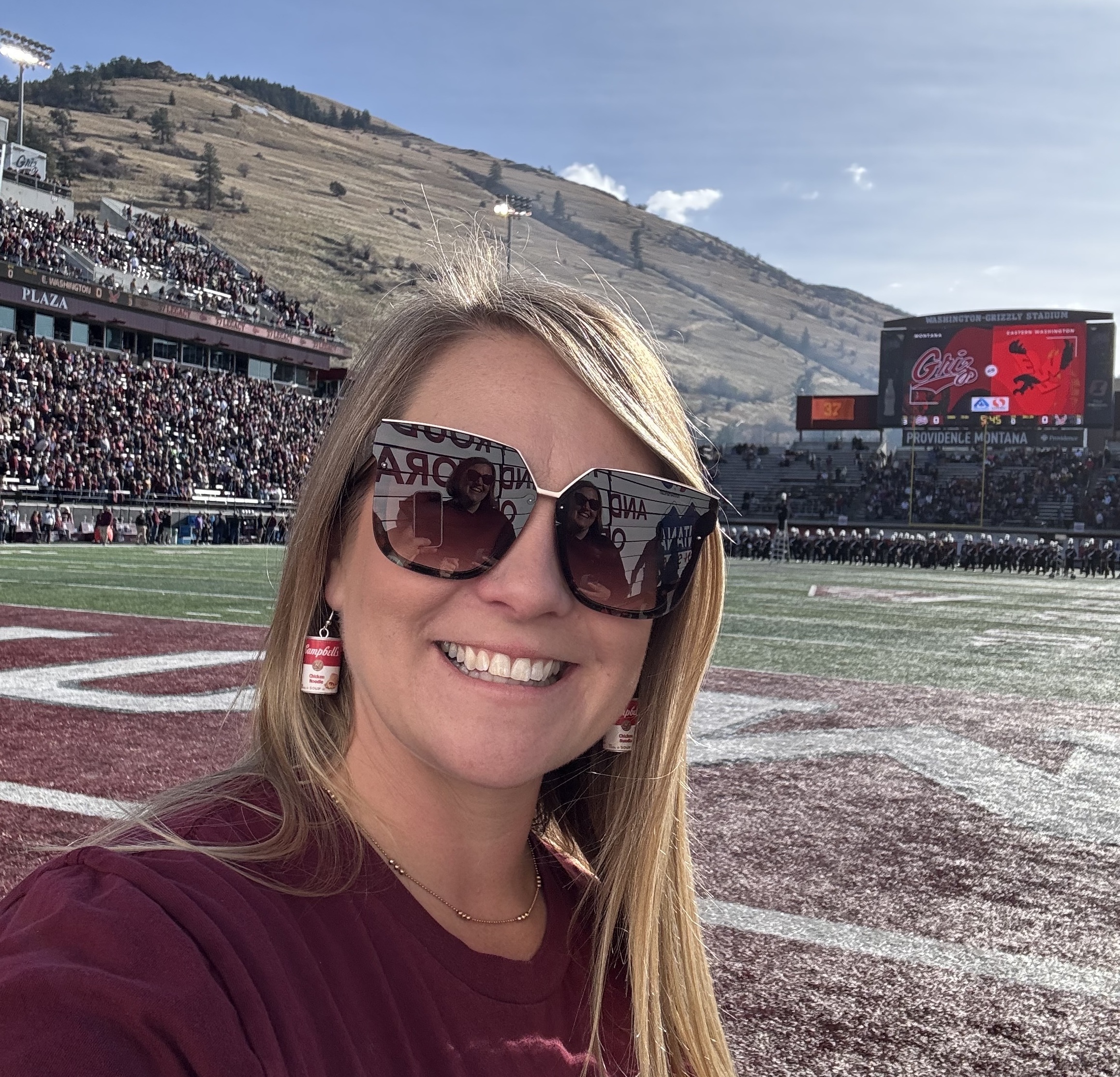
One of Amy Allison’s favorite responsibilities as executive director of Missoula Food Bank and Community Center is helping customers in the store downstairs.
“I’m still a social worker,” the 2007 University of Montana graduate said.
Before joining the food bank, Allison spent five years leading the Poverello Center, including through the COVID-19 pandemic and some exceptionally challenging years. She remains deeply proud of that work at the non-profit homeless shelter and social service organization. Still, she needed a change.
At the food bank, that commitment takes another form. It serves one in five people in Missoula County. Last summer, it distributed more than 60,000 meals to children who typically rely on school meals. Its EmPower Packs program sends food home in children’s backpacks on Fridays, helping bridge the weekend. Annual distribution has grown from about 27,000 packs, when the organization moved into its current building, to more than 60,000, Allison said.
For Allison, the scale of the operation matters, but so does each customer’s experience. That means paying attention to how people are treated – not simply whether they leave with groceries. She wants the food bank to offer the best customer service in town. She also wishes more people understood that some of its customers are volunteers. Needing help and offering it can be parts of the same person’s life.
Allison arrived at UM in 2003 from Havre, where her parents emphasized a college education. She had worked since age 14, first at Taco John’s and later Orange Julius. College would mean continuing to work, but it also meant Missoula, a place she had long wanted to live.
She planned to study psychology, perhaps continuing toward a doctorate. A freshman interest group gave her classmates she saw repeatedly and friendships that outlasted the shared schedule. They still gather for dinner and still take getaways together when they can.
“They’re still like very close friends of mine to this day,” she said. “We have a group chat that's going constantly.”
She began volunteering at the YMCA, where she found paid work and her professional plans began to change. Supporting people escaping domestic violence introduced her to the connections among safety, housing and access to resources. Social work offered a way to address those connections.
She chose UM’s master’s program for its breadth: preparation for working with individuals, but also with organizations and communities. She earned her Master of Social Work in 2011 while working full time at the Poverello Center. In Libby, she subsequently helped a psychologist develop an integrated behavioral health program at a community health center. Community mental health work in Great Falls and leadership of Montana’s chapter of the National Association of Social Workers followed.
Returning to the Poverello Center as executive director brought responsibilities that were sometimes far removed from counseling or advocacy. Two catastrophic plumbing failures within three months required raising $240,000 for repairs. During COVID-19, staffing shortages threatened a temporary closure. This led Allison to work with local officials to secure National Guard assistance and help orient Guard members to shelter operations.
There were difficult conversations, too, with people who questioned why the shelter fed or housed its guests. Allison learned to bring those exchanges back to particular circumstances: military service, medical debt, housing costs, someone entering shelter for the first time.
“Humanizing people has been a really important part of that conversation,” she said.
Allison loved the work and still misses it. But leading through the pandemic and other sustained challenges had taken a toll. Recognizing that she needed a change meant making room for her family and recovering the energy and creativity she wanted to bring to her work. A year as clinical director at Open Aid Alliance preceded her move to the food bank.
The move was a way to continue serving the community on more sustainable terms without diminishing her commitment to people experiencing homelessness or the organizations supporting them.
The organization’s demands nevertheless follow the rhythms of family life. Weekends interrupt access to school meals. Summer stretches that interruption across months. While donors often think of the food bank during the holidays, Allison points to summer as a period when families face higher grocery bills and volunteers are harder to find. Protein and produce are persistent needs. She encourages gardeners to consider planting an extra row to share.
She also wishes more people knew how many customers volunteer.
“The number of our customers that also volunteer here is incredible,” she said. “And a lot of times people don’t know that.”
Helping in the store remains one of her favorite responsibilities. “I’m still a social worker,” she said.
This month, Can the Cats, running through Nov. 21, supports that work through the annual food-and-fundraising competition benefiting Missoula Food Bank and Community Center and the UM Food Pantry. Allison welcomes both food, which adds variety, and financial gifts, which support bulk purchasing. Participation details are available at canthecats.com.
“Can the Cats is one of our favorite times of the year,” she said. “It is our largest food drive.”
On Fridays, Allison leads a seminar for UM social work graduate students, helping connect classroom learning with their practicum experiences. She brings examples from meetings with elected officials and years of nonprofit leadership. She also brings a lesson learned in graduate school: People doing difficult work need colleagues they can turn to themselves.
Friends and peers have listened, helped solve problems and brought snacks for her staff during hard periods.
“This work can be really hard for so many reasons,” Allison said. “I think about just how important it is to have a group of folks in my world that I can lean on.”